Division Two · Export
Sodium Lignosulphonate, on spec and on the water
Our SLS division exists to do one thing exceptionally well: get consistent, on-spec Sodium Lignosulphonate out of South Africa and onto your plant floor, whether that plant is in Nhava Sheva, Mundra, Jebel Ali, Jakarta, Ho Chi Minh City or Mombasa.
Product description
Norritrade SLS
CAS No: 8061-51-6
A brown, water-soluble powder derived from the neutral sulphite semi-chemical pulping of eucalyptus and pine wood. Bio-based, renewable, and biodegradable. It works as a binder, a dispersant and a water reducer across mining, construction, agriculture and ceramics. One material doing volume industrial duty rather than a specialty additive priced like one.
Product specification
- Appearance
- Brown powder
- pH (10% solution)
- 7 ± 1
- Total solids (%)
- 95
- Water insoluble material
- < 1
Typical values (w/w %)
- Ash
- 31 - 37
- Total sugars
- 10 - 17
- Chlorides (Cl)
- 0.1 - 0.3
- Sodium (Na)
- 12 - 15
- Sulphate (SO₄²⁻)
- 5 - 11
- Lignosulphonate
- 45 - 55
Specifications are average values and may change. All values are calculated on a dry basis where applicable. Packaging: 600 kg bulk bags. SDS available on request.
Applications
Where our SLS earns its place
Dust suppression and road stabilisation
Binds fines on haul roads, stockpiles and unpaved surfaces into a crust that holds, and draws moisture out of the air to keep holding it. Field studies put dust reduction between 47 and 83 percent, lasting six to twelve months.
Sprayed at 80 to 120 grams of solids per square metre, or mixed in at 1 to 3 percent for base stabilisation. Water insolubles under 1 percent means it passes through standard spray nozzles without blocking them. At 95 percent solids you are freighting product, not water.
Briquetting and agglomeration
Coal fines, coke breeze, mineral fines, charcoal and biochar. At 5 to 8 percent of the briquette this is the highest-consumption application we supply. One plant can take more tonnage than twenty admixture customers.
A South African study on inertinite-rich coal fines recorded 16 MPa compressive strength at 7.5 percent lignosulphonate loading, second only to polyester resin, at roughly a thirteenth of the cost. Green and dry strength are strong. Like all organic binders it burns out during firing, so where fired strength is the requirement an inorganic co-binder is still needed.
Fertiliser granulation and anti-caking
Improves granule hardness, reduces caking in storage and cuts dust through handling and long-haul transport. Applied at 0.1 to 1.0 percent, in a coating solution or incorporated during granulation.
This is one of the uses where our assay simply does not engage. You are buying binding solids, and sulphate is a nutrient here rather than a contaminant.
Ceramic body binder
Wall and floor tile, sanitaryware and refractory shapes. Raises green and dry strength in pressed and extruded bodies, which allows lower plastic clay content and cuts handling losses before firing.
Dosed at 0.1 to 0.3 percent of the body: trace ash into a body that already carries sodium fluxes. Dose on active content rather than by weight.
For casting-slip deflocculation we recommend a trial rather than a specification. Slip rheology is sensitive to soluble sulphate and ours runs 5 to 11 percent. We will send material to test.
Concrete, mortar and render
A water-reducing and retarding plasticiser. It disperses cement agglomerates so the mix flows at a lower water-to-cement ratio, which raises strength after hardening.
The residual sugar content extends setting time. In hot climates with long haul distances that is worth having rather than working around, and it puts the material toward water-reducing-and-retarding duty rather than plain water reduction. Typical dosage is 0.3 to 0.65 percent by weight of cement.
We do not claim ASTM C494 or EN 934-2 classification. Classification requires testing on your mix design, with your cement and your aggregate. We would rather send you material to run that trial than put a claim in a brochure.
Where this grade is not the right answer
This is a standard industrial grade at 45 to 55 percent lignosulphonate, with ash at 31 to 37 percent and sugars at 10 to 17 percent. Those numbers rule out several applications that need a purified or chemically modified product. If your requirement is on this list, a refined grade from a specialist producer is the right answer, and we will tell you so rather than sell you a container that fails your trial.
- Lead-acid battery negative plate expanders
- Disperse and vat dye dispersants
- Wettable powder and water-dispersible granule agrochemical formulations
- Gypsum plasterboard
- Anything specifying low ash, low conductivity or food-contact grade
If you convert crude lignosulphonate into chrome, ferrochrome or chrome-free products, that is a different conversation and one we are interested in having.
Global logistics
Export is not an afterthought here. It is the whole design
Packed for the long haul
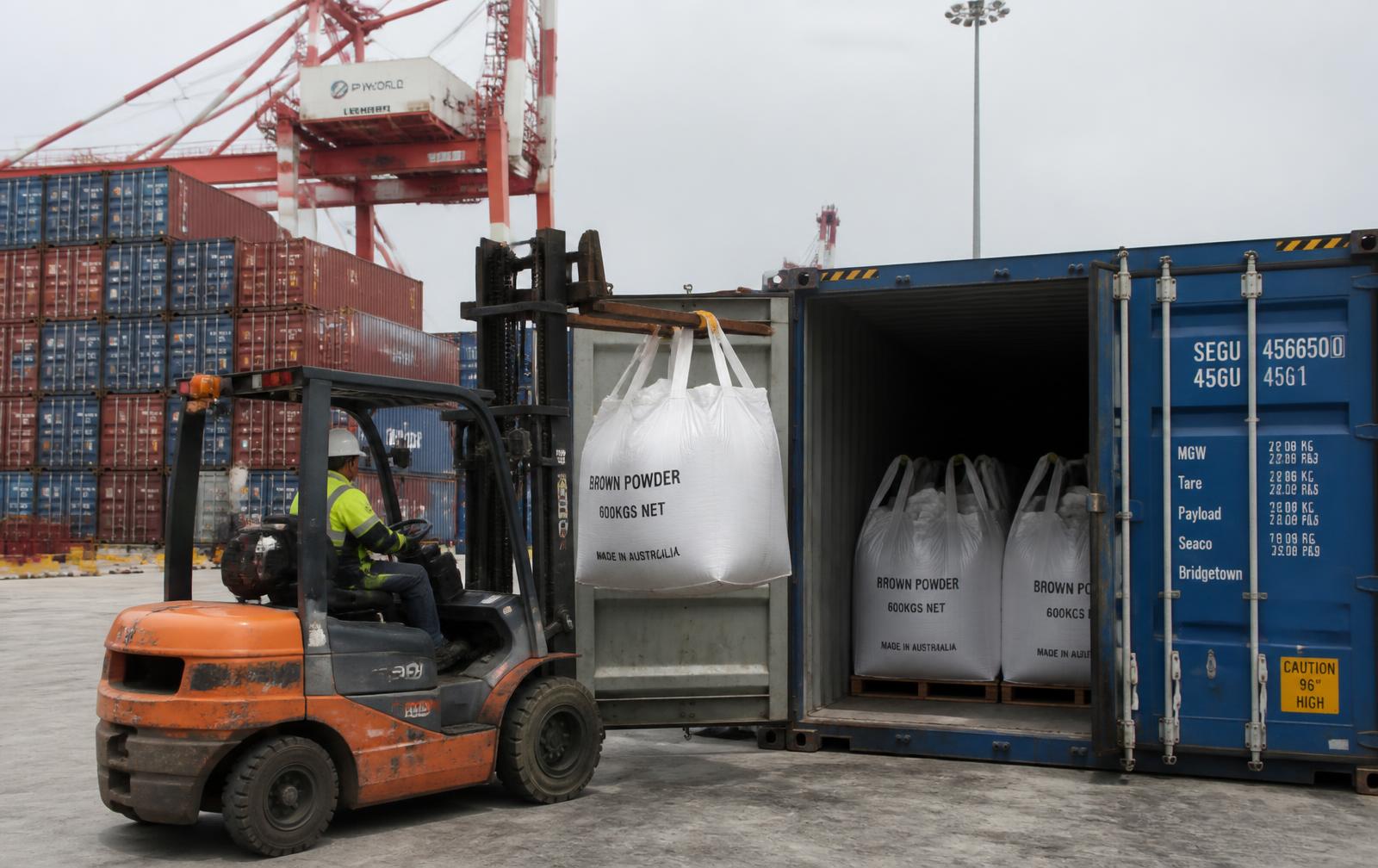
600 kg bulk bags, sealed with inner liners and palletised. Loaded, dunnaged and secured to survive a full ocean leg without moisture pick-up or bag failure.
FOB Durban, CIF on request
Quoted FOB Durban as standard, Incoterms 2020. CIF to your nominated discharge port on request. We handle stuffing and the export leg, so you hold one point of contact through to the bill of lading.
Documentation done properly
Certificate of analysis per batch, SDS on request, packing list, commercial invoice, bill of lading and certificate of origin issued together, with no chasing.
Volume that scales
From a single trial container to repeat monthly programmes. One mill, one process, one specification, not aggregated from multiple origins and not re-bagged traded material. What you qualify is what keeps arriving.
Ready to price a container?
Give us the application, your discharge port and your annual volume. We will come back with a specification review, sample material where it makes sense, and a firm price.
Request an SLS quotation